A Complete Guide to Scalable XML API Connectivity
The travel industry has become increasingly competitive, with customers expecting instant search results, competitive pricing, and access to a wide range of travel services from a single platform. Whether users are booking flights, hotels, transfers, tours, or holiday packages, they want real-time availability, flexible options, and a seamless booking experience. For travel businesses, meeting these expectations requires more than connecting to a single travel supplier.
This is where multi-supplier integration becomes essential. Instead of relying on one API provider, modern travel portals connect with multiple suppliers, including Global Distribution Systems (GDS), hotel wholesalers, airlines, consolidators, and destination management companies (DMCs). By aggregating data from various sources, travel portals can offer broader inventory, better pricing, and improved booking reliability.
However, integrating multiple suppliers is much more than simply connecting several APIs. Every supplier follows different data formats, pricing structures, booking flows, and response standards. Without a well-planned integration strategy, travel portals can face issues such as duplicate listings, inconsistent pricing, slower search performance, and failed bookings.
A successful multi-supplier integration strategy focuses on creating a unified system that standardizes supplier data, prioritizes the best inventory, synchronizes bookings in real time, and ensures a smooth customer experience.
In this blog, you’ll learn what multi-supplier integration is, why modern travel portals depend on it, how it works behind the scenes, and the key strategies that help travel businesses build scalable, high-performance booking platforms.
What Is Multi-Supplier Integration in Travel Portals?
According to the IT4T Solutions – Multi-supplier integration is the process of connecting a travel portal with multiple travel service providers through XML or REST APIs. It allows the portal to access inventory from different suppliers within a single booking platform, improving availability, pricing, and booking success.
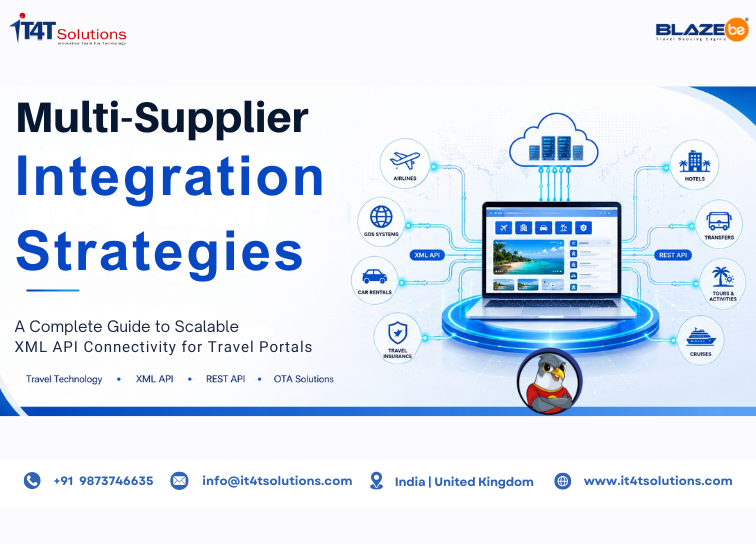
Unlike traditional travel websites that depend on a single supplier, modern Online Travel Agencies (OTAs) aggregate travel content from several providers. These may include airlines, hotel wholesalers, GDS platforms, transfer providers, sightseeing companies, and car rental suppliers.
Each supplier maintains its own inventory, pricing model, booking rules, cancellation policies, and API specifications. A travel portal collects this information, standardizes the data, and presents users with a unified search experience.
For example, when a traveller searches for hotels in Dubai, the portal may simultaneously request hotel availability from multiple suppliers. Instead of displaying separate results for each supplier, the system intelligently combines, filters, and ranks the inventory to present the most relevant options.
This approach gives customers access to a wider selection of accommodations while allowing the portal to choose the supplier offering the best availability, pricing, or commission for each booking.
Common Travel Suppliers Connected Through APIs
A modern travel portal can integrate with multiple categories of suppliers, including:
- Global Distribution Systems (GDS)
- Hotel wholesalers
- Airline consolidators
- Low-cost carrier APIs
- Tour and activity providers
- Transfer suppliers
- Car rental providers
- Cruise suppliers
- Insurance providers and many more…
By combining these services, travel businesses can create a comprehensive booking platform that meets diverse customer needs without depending on a single inventory source.
Why Travel Portals Need Multiple Suppliers
Travel portals need multiple suppliers because no single provider can deliver complete global inventory, the best prices, and consistent availability across every destination and travel service. Multi-supplier integration helps improve customer choice, booking reliability, and business scalability.
Customer expectations have evolved significantly over the past decade. Travelers compare prices across multiple websites before making a booking and expect instant access to the best available deals. A travel portal that depends on only one supplier often struggles to meet these expectations.
Broader Inventory Coverage
Every supplier has unique partnerships with airlines, hotel chains, and local travel providers. By integrating multiple suppliers, travel portals significantly expand their available inventory.
For example, one hotel wholesaler may offer excellent coverage in Europe, while another provides stronger inventory across Southeast Asia. Combining both suppliers creates a much richer booking experience for customers.
A larger inventory also increases the likelihood that travellers will find accommodation or flights that match their budget, preferences, and travel dates.
More Competitive Pricing
Travel prices vary between suppliers due to different contracts, negotiated rates, and commission structures.
When multiple suppliers are connected, the booking engine can compare available options and display the most competitive price. This improves customer satisfaction while helping travel businesses maintain healthy profit margins through flexible markup strategies.
Instead of being locked into one supplier’s pricing model, businesses gain greater control over revenue optimization.
Higher Booking Success Rate
Inventory availability changes constantly. Hotels sell out, airlines update seat availability, and suppliers occasionally experience downtime.
With multiple suppliers integrated into the portal, the booking engine can automatically retrieve inventory from alternative providers when one supplier cannot fulfill a request.
This reduces booking failures and creates a more reliable customer experience.
Reduced Business Risk
Depending on a single supplier creates operational risks. If that supplier experiences technical issues, pricing errors, or service interruptions, the entire travel portal may be affected.
Multi-supplier integration distributes this risk across multiple providers, improving business continuity and operational resilience.
Better Customer Experience
Ultimately, customers benefit from greater choice, accurate pricing, faster search results, and more successful bookings.
A positive booking experience encourages repeat customers, improves brand reputation, and increases long-term customer loyalty.
How Multi-Supplier Integration Works
World Best Travel Technology Company – IT4T says that. Multi-supplier integration works by connecting multiple travel APIs to a centralized integration layer that standardizes supplier data, applies business rules, and delivers unified search results to the travel portal in real time.
Although the customer experiences a simple booking process, multiple systems work together behind the scenes.
Step 1: Customer Initiates a Search
A traveller searches for a flight, hotel, transfer, or holiday package by entering details such as destination, travel dates, and passenger information.
The travel portal immediately forwards this request to its integration engine.
Step 2: API Requests Are Sent to Multiple Suppliers
Instead of querying only one supplier, the integration engine sends simultaneous API requests to multiple travel providers.
Each supplier responds with its own inventory, pricing, availability, cancellation rules, and booking conditions.
Since every supplier uses different API structures, the returned data is often inconsistent.
Step 3: Data Normalization and Mapping
One of the most critical stages is data normalization.
The integration layer converts supplier-specific responses into a standardized format by mapping fields such as hotel names, room types, amenities, pricing, currencies, cancellation policies, and availability.
This ensures that search results remain consistent regardless of which supplier provided the data.
Step 4: Business Rules and Supplier Prioritization
Once the data has been standardized, the portal applies predefined business rules.
These rules may prioritize suppliers based on factors such as:
- Lowest available price
- Highest commission
- Fastest API response
- Preferred business partnerships
- Regional inventory strength
- Supplier reliability
This intelligent decision-making process helps deliver optimal booking options while supporting business objectives.
Step 5: Unified Results Are Displayed
After filtering duplicate inventory and ranking available options, the travel portal displays a single, user-friendly list of search results.
Customers never see the complexity of multiple supplier integrations. Instead, they enjoy a fast, seamless booking experience with comprehensive travel options presented in one interface.
As travel technology continues to evolve, this centralized integration approach has become the foundation of scalable, high-performance travel portals capable of serving customers across global markets.
Challenges in Multi-Supplier XML/API Integration
Integrating multiple travel suppliers offers significant business advantages, but it also introduces technical complexities. Travel portals must manage different API standards, inconsistent data formats, pricing variations, and real-time synchronization to ensure a seamless booking experience.
Without a well-planned integration architecture, these challenges can negatively impact website performance, booking accuracy, and customer satisfaction.
Different API Standards and Data Formats
Every travel supplier develops APIs based on its own specifications. Some providers still use XML APIs, while others offer REST APIs with JSON responses. Even suppliers using the same technology often structure their data differently.
For example, one hotel supplier may return room names, meal plans, and cancellation policies using one format, while another uses completely different field names and response structures.
To overcome this challenge, travel portals should implement a centralized data mapping layer that converts supplier-specific responses into a standardized internal format. This ensures consistency across the entire booking platform.
Duplicate Inventory
When multiple suppliers provide inventory for the same hotel, flight, or travel service, duplicate listings become common.
Imagine searching for a hotel in Singapore and seeing the same property listed four or five times with slightly different prices. This creates confusion, reduces user trust, and makes comparing options difficult.
A robust duplicate detection system should compare identifiers such as hotel names, addresses, geo-coordinates, star ratings, and supplier IDs to merge similar listings into a single result while retaining the best available offer.
Pricing and Currency Inconsistencies
Travel suppliers frequently update their prices based on demand, exchange rates, and promotional campaigns. Some suppliers return prices in USD, while others use EUR, GBP, or local currencies.
Without proper normalization, customers may see inconsistent pricing or inaccurate fare comparisons.
A centralized pricing engine should standardize currencies, calculate markups, apply business rules, and display transparent pricing across all suppliers.
API Response Time Differences
Not every supplier responds at the same speed. Some APIs return results in less than a second, while others may take several seconds.
If a travel portal waits for every supplier to respond, the overall search experience becomes slow.
Using asynchronous API requests, timeout limits, and intelligent caching helps display search results faster while allowing slower suppliers to load in the background when appropriate.
Booking Synchronization Issues
Availability changes rapidly in the travel industry. A room available a few seconds earlier may already be booked through another channel.
To reduce booking failures, travel portals should perform real-time availability checks before confirming reservations and immediately synchronize booking confirmations across connected suppliers.
Supplier Downtime and Error Handling
Even reliable travel suppliers occasionally experience maintenance, server outages, or temporary API failures.
Without a fallback strategy, customers may encounter failed searches or incomplete booking results.
A resilient integration platform automatically switches to alternative suppliers whenever one becomes unavailable, ensuring uninterrupted service.
Effective Multi-Supplier Integration Strategies
A successful multi-supplier integration strategy focuses on standardizing supplier data, improving system performance, and ensuring reliable booking workflows. These strategies help travel portals deliver accurate results while maintaining scalability and operational efficiency.
Choose the Right Supplier
Selecting more suppliers does not automatically improve a travel portal.
Instead, businesses should evaluate suppliers based on inventory coverage, API stability, pricing competitiveness, response speed, regional expertise, and technical support.
A balanced supplier portfolio reduces dependency on any single provider while maximizing inventory quality across different destinations and travel services.
Build a Unified API Layer
Rather than allowing every application module to communicate directly with multiple suppliers, create a centralized API integration layer.
This middleware acts as a bridge between suppliers and the travel portal by handling authentication, request routing, response processing, data mapping, caching, and business rules.
A unified architecture simplifies future integrations because new suppliers can be added without modifying the booking engine or frontend application.
Normalize Supplier Data
Data normalization is one of the most critical components of multi-supplier integration.
Regardless of how suppliers structure their responses, the portal should convert all inventory into a consistent format. Hotel names, room categories, amenities, cancellation policies, currencies, taxes, and pricing should follow standardized internal models.
This improves search accuracy, simplifies filtering, and provides users with a consistent booking experience.
Implement Smart Supplier Prioritization
Not every supplier should receive equal priority.
Travel portals can define business rules that automatically select the best supplier based on factors such as:
- Lowest net rate
- Fastest response time
- Highest commission
- Preferred supplier agreements
- Regional inventory strength
- Historical booking success
Dynamic supplier prioritization improves both customer satisfaction and business profitability.
Use Real-Time Caching
Repeated API requests increase server load and slow down search performance.
Caching frequently searched destinations, hotel details, static content, and supplier metadata significantly reduces API calls while improving response times.
However, cache policies should be carefully managed to ensure customers always receive accurate availability and pricing.
Implement a Reliable Failover Mechanism
Supplier downtime should never stop customers from booking travel services.
A failover mechanism automatically redirects search requests to alternative suppliers whenever the primary supplier becomes unavailable or exceeds response time limits.
This strategy improves booking reliability while minimizing revenue loss caused by supplier outages.
Synchronize Bookings Across Suppliers
Once a booking is confirmed, every connected system must immediately receive updated inventory information.
Real-time synchronization reduces the risk of overbooking, duplicate reservations, and inventory mismatches across suppliers.
Modern travel platforms often use webhooks, event-driven architecture, or message queues to improve synchronization reliability.
Automate Error Handling and Monitoring
Travel API integrations require continuous monitoring.
Every failed API request, timeout, authentication issue, or unexpected response should be automatically logged and analysed.
Monitoring dashboards, alert systems, retry mechanisms, and performance analytics enable technical teams to identify issues before they affect customers.
Best Practices for Multi-Supplier Travel Portal Development
Following industry best practices helps travel businesses build scalable, secure, and future-ready multi-supplier integration platforms that can adapt to evolving supplier APIs and growing customer demand.
Start by designing a modular integration architecture. Keeping supplier connectors independent makes it easier to update or replace individual integrations without disrupting the entire platform.
Maintain detailed API documentation for every supplier, including authentication methods, request parameters, response formats, rate limits, and version history. Good documentation accelerates maintenance and future development.
Implement robust security measures such as encrypted API communication (HTTPS), secure API key management, authentication tokens, and role-based access controls to protect sensitive customer and booking data.
Continuously monitor API performance using logs, dashboards, and automated alerts. Tracking response times, error rates, and supplier availability helps identify performance bottlenecks before they impact users.
Finally, plan for scalability from the beginning. As your business grows, you’ll likely integrate additional airlines, hotel wholesalers, transfer providers, and travel services. A flexible architecture supported by cloud infrastructure, load balancing, and scalable databases ensures your travel portal can handle increasing traffic without sacrificing speed or reliability.
A well-designed multi-supplier integration platform is not simply about connecting APIs—it is about creating an intelligent ecosystem that delivers fast searches, accurate pricing, reliable bookings, and a seamless travel experience for customers while supporting long-term business growth.
Benefits of Multi-Supplier Integration
With over 20+ years of experience in the travel technology industry, IT4T Solutions believes that. Multi-supplier integration enables travel businesses to offer broader inventory, competitive pricing, faster bookings, and a more reliable customer experience. By connecting multiple travel suppliers through a unified platform, travel portals become more scalable, efficient, and resilient.
While the technical implementation requires careful planning, the long-term business benefits make it a worthwhile investment for travel agencies, OTAs, and travel technology companies.
Access to a Larger Inventory
One of the biggest advantages of multi-supplier integration is expanded inventory. Since every supplier has different partnerships with airlines, hotels, transfer companies, and tour operators, combining multiple sources significantly increases the number of travel options available to customers.
A wider inventory not only improves customer satisfaction but also increases the likelihood of converting visitors into paying customers.
Better Pricing and Revenue Opportunities
Different suppliers often offer different net rates for the same travel product. A multi-supplier travel portal can compare these rates in real time and display the most competitive option.
At the same time, travel businesses can apply customized markup rules, promotional pricing, and commission strategies to maximize profitability without compromising customer value.
Higher Booking Success Rate
Supplier outages, sold-out inventory, or temporary API failures are common in the travel industry.
With multiple suppliers connected to the booking engine, the system can automatically switch to an alternative provider when the preferred supplier cannot fulfil a booking request. This reduces failed bookings and improves customer confidence.
Improved User Experience
Customers expect fast search results and accurate information.
By combining intelligent caching, supplier prioritization, and real-time synchronization, travel portals can deliver a seamless booking experience with reliable pricing and up-to-date availability.
A better user experience often leads to higher customer retention, positive reviews, and increased repeat bookings.
Long-Term Scalability
As travel businesses expand into new destinations or services, additional suppliers can be integrated without redesigning the entire platform.
A scalable integration architecture allows businesses to support growing customer demand while remaining flexible enough to adopt new technologies and supplier partnerships.
Industries That Benefit from Multi-Supplier Integration
Although multi-supplier integration is commonly associated with Online Travel Agencies (OTAs), many types of travel businesses benefit from this approach.
These include:
- Online Travel Agencies (OTAs)
- B2B Travel Portals
- B2C Booking Platforms
- Tour Operators
- Destination Management Companies (DMCs)
- Corporate Travel Management Companies
- Hotel Booking Platforms
- Flight Aggregators
- Holiday Package Providers
- Travel Technology Companies
Whether the goal is to increase inventory, improve booking performance, or expand into international markets, multi-supplier integration provides the flexibility needed to support long-term business growth.
Why Choose IT4T Solutions for Multi-Supplier XML API Integration?
Choosing the right technology partner is just as important as selecting the right travel suppliers. A successful integration project requires technical expertise, scalable architecture, and ongoing support to ensure reliable performance.
At IT4T Solutions, we specialize in developing high-performance travel technology solutions that simplify complex API integrations. Our team has extensive experience integrating XML and REST APIs for flights, hotels, transfers, sightseeing, car rentals, and other travel services.
Our multi-supplier integration approach focuses on:
- Unified XML and REST API integration
- Intelligent supplier data normalization
- Custom API mapping and transformation
- Duplicate inventory management
- Supplier prioritization and business rules
- Real-time booking synchronization
- Secure API authentication and data protection
- Performance optimization and caching
- Continuous monitoring and maintenance
Whether you’re launching a new travel portal or modernizing an existing booking platform, our solutions are designed to deliver scalability, reliability, and exceptional user experiences.
As customer expectations continue to evolve, relying on a single travel supplier is no longer enough for businesses that want to remain competitive. Modern travel portals must deliver extensive inventory, accurate pricing, fast search performance, and reliable bookings across multiple travel services.
A well-planned multi-supplier integration strategy makes this possible by bringing together multiple travel providers within a unified platform. Through standardized data mapping, intelligent supplier prioritization, real-time synchronization, and scalable system architecture, travel businesses can improve operational efficiency while delivering a superior booking experience.
Whether you’re building a new OTA, upgrading an existing travel portal, or expanding your travel technology ecosystem, investing in a robust multi-supplier integration framework can help you reduce operational risks, improve customer satisfaction, and support sustainable business growth.
If you’re looking for a trusted technology partner to implement secure and scalable Travel XML API integrations, IT4T Solutions can help you build a future-ready travel platform tailored to your business goals.